



When temperatures rise in the summer, millions of people head to the water. Whether it’s relaxing at the lake, visiting public pools, or enjoying a cold, refreshing drink straight from the tap. The availability of clean water is something wetake for granted as part of our quality of life. This makes what happens behind the scenes all the more critical: securing our water supply and wastewater management systems.
The water sector forms the foundation for society, the economy, and human and environmental health. While advancing digitalization and process automation optimize operations, they simultaneously create new attack surfaces for internal errors and cyberattacks.
A prominent example highlighted the urgency of this topic several years ago: the near-miss incident at a water utility in Oldsmar (Florida), where the water quality was suddenly put at risk. The fact that nothing worse happened was thanks to fortunate circumstances. However, because the necessary visibility into Operational Technology (OT) was lacking, it remained unclear for two years whether it was a targeted cyberattack or an internal operator error.
Threat landscape and operational challenges in the water industry
In recent years, large-scale, successful attacks on physical control systems (OT) have remained the exception. However, incidents at home and abroad, such as ransomware attacks on IT service providers for municipal utilities, demonstrate how quickly ripple effects can hit water suppliers.
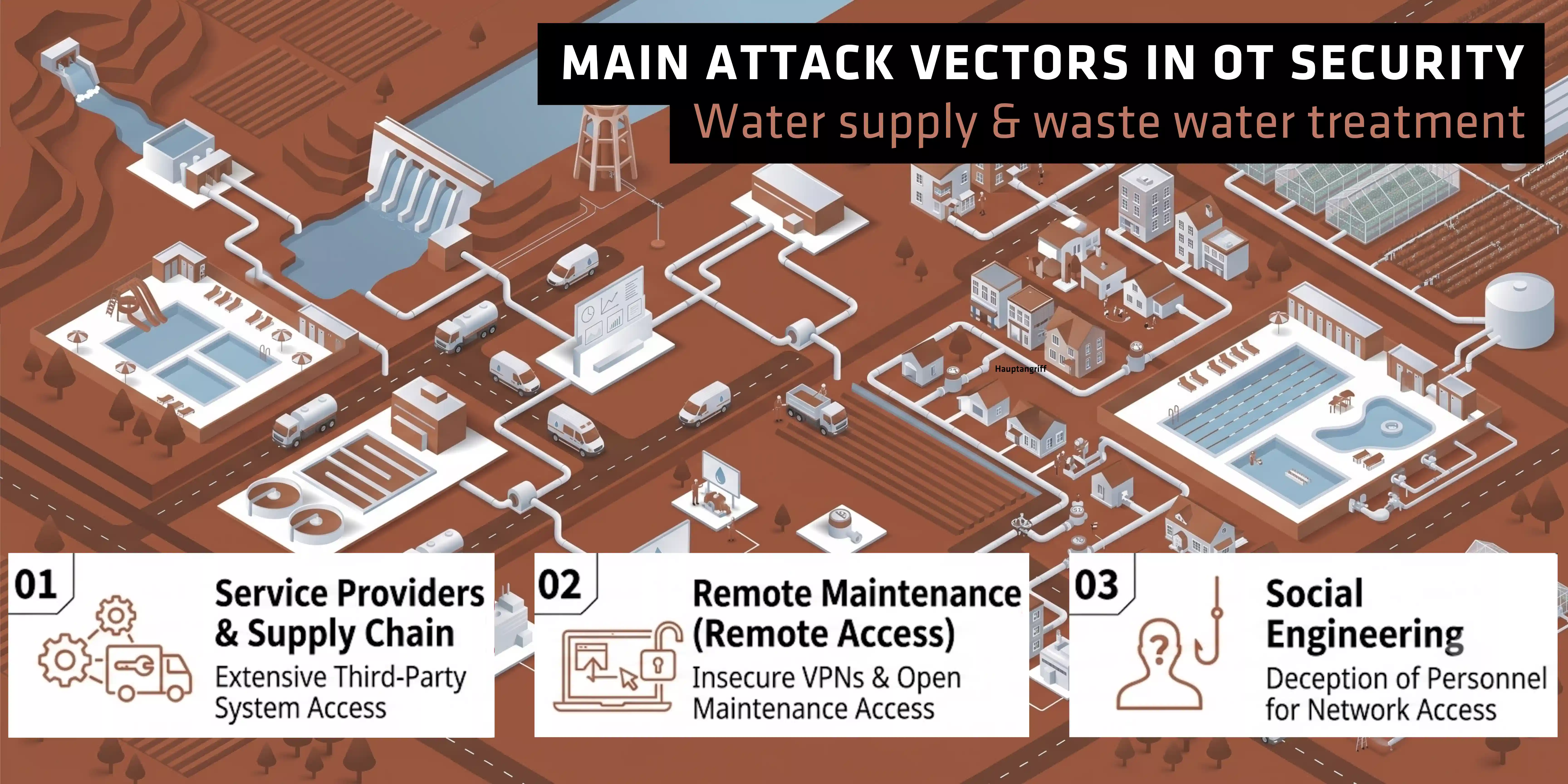
Among the industry's greatest challenges are:
- Severe shortage of skilled labor: IT/OT security experts simply don’t grow on trees in the water sector. On-site operational staff primarily focus on treating drinking water and complying with environmental thresholds, not on analyzing security advisories.
- Outdated infrastructure ("legacy OT"): Many control systems in process and network control technology have been running for decades under the principle of "never change a running system". These systems usually lack basicnative security mechanisms or encryption.
- Lack of transparency & asset visibility: Operators often lack a detailed, up-to-date inventory of which components (assets), firmware versions, and communication paths actually exist within their control systems.
- Fragmented market: Many countries have several thousand water utilities. Small and medium-sized operations in particular can rarely afford or staff a dedicated, 24/7 Security Operations Center (SOC).
Legal pressure and regulatory guardrails
Hand in hand with the dynamic threat landscape, lawmakers are noticeably tightening the screws on Critical Infrastructure (CRITIS) operators. Utilities are under pressure to secure their systems according to the state of the art:
- NIS2 directive: Previously, only a small fraction of the water industry was regulated. By significantly lowering the threshold limits, medium-sized utilities will also fall under strict requirements in the future (including mandatory attackdetection systems, expanded reporting duties, and direct executive liability).
- B3S water/wastewater: This industry standard serves as the framework for implementing baseline IT security (IT-Grundschutz) in the water sector. It recommends a risk-based approach through the implementation of an Information Security Management System (ISMS) and Business Continuity Management (BCM).
- DVGW / DWA regulations: Guidelines such as the DWA-M 1060 advisory note or B3S project modules require detailed risk identification, network segmentation, and proof of the effectiveness of security measures.
Solutions: Sector SOCs, industry associations, and passive OT monitoring
To bridge the gap between regulatory obligations and a lack of resources, associations and sector initiatives are turning to collaborative, pragmatic models.
1. The sector SOC as a "Sharing Community"
Through initiatives like the Competence Center Digital Water Industry (KdW) and the Cybersec@Wasser Situation Center in Germany offer the industry access to a joint approach.
The core idea: Specialized attack detection is made accessible to both tiny and large-scale utilities without requiring every single facility to maintain its own 12-person IT security team. The Sector SOC aggregates specific OT expertisefor the water industry, centrally analyzes anomaly reports, and alerts operators in a targeted manner during emergencies. You can hear more about this in the podcast featuring Roland Derler from KdW.
2. Industrial network monitoring with anomaly detection
To detect attacks or technical glitches before water quality or supply is compromised, passive network monitoring forms the centerpiece of a modern defense-in-depth strategy:
- Non-intrusive visibility: The monitoring passively reads control communication within the network without disrupting sensitive real-time processes.
- Deep Packet Inspection (DPI): By decoding industrial protocols down to the value level, unauthorized remote access, configuration changes on PLCs, or corrupted telegrams are identified immediately.
- Detection of known & unknown threats: While traditional IT firewalls only act at network boundaries, anomaly detection also identifies malicious behavioral deviations inside the OT network (e.g., insider threats, zero-day exploits, or mistakes made by maintenance personnel).
- Targeted emergency & incident response training: To master critical situations, practical training is gaining importance (similar to sector initiatives like the Cyber Range in the energy sector).
Conclusion
The transformation of the water industry requires a mindset shift: Cybersecurity is not merely an IT project; it is an integral component of supply reliability and risk management at the executive level. By combining passive OT network monitoring with integration into industry-specific Sector SOCs or external expertise, water utilities of any size can meet regulatory mandates and safeguard water quality for the long term. More information on passive OT monitoring can be found here.


